Hōsō
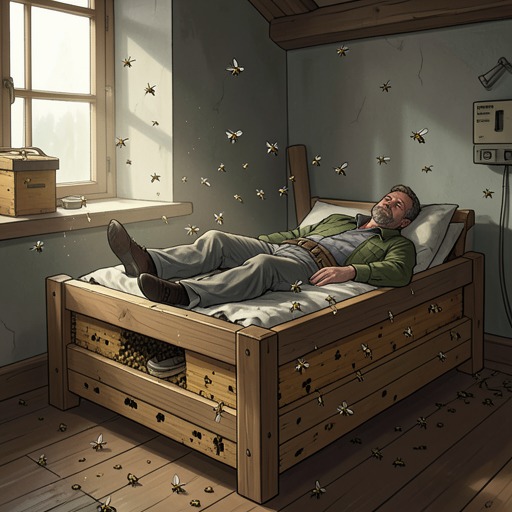
Grey BeesThe bee-bed is Sergeyich’s improvised bed, assembled from the hives that make up his apiary. First imagined as a way to recover from a numb left arm, it becomes a real sleeping place in Crimea and then a threshold between bodily pain, remembered home, and dream. Its force lies in that double character: it is made from working hives, not from a cure, yet sleeping on it allows Sergeyich to imagine himself restored and to wake with his arm moving again.
Origin and Purpose
Sergeyich’s idea begins in a memory of sleeping on his bee-bed beneath the trees in Little Starhorodivka. He recalls waking refreshed by the power of several hundred thousand bees, and remembers the former governor climbing down from the platform with a joyful smile after sleeping there for hours. Now, feeling broken and powerless after a night in which his arm has gone numb, Sergeyich hopes the same restorative sleep might bring back his strength. The memory gives him a practical aim: to arrange his hives as a bed and rest among his bees.
He has five hives available, not the six he thinks would make a proper bed. He considers whether he can manage with five by using one hive as a support for his head. The missing hive makes the arrangement awkward rather than impossible, and Sergeyich tests the narrow end in both directions before deciding where his head should go. He tops the hives with his sleeping bag in place of a straw-filled mattress, turning equipment for the bees into a surface for his own rest.
The construction also depends on the bees’ routines and on help from others. After learning that a hive has been taken away, Sergeyich asks Aisylu for assistance in building the bed. He insists the work must wait until dusk, when the bees have returned, so that they do not lose their familiar location. Because the task requires two people and he cannot manage it alone, Aisylu agrees to help. The platform is thus not simply assembled around his needs: its timing is governed by the bees’ attachment to the place, and its making acknowledges his temporarily limited strength.
Sleeping Among the Hives
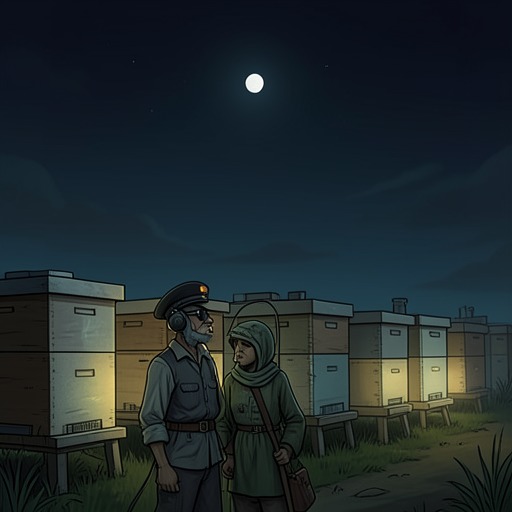
Once the hives are arranged, Sergeyich lies on his back in his sleeping bag and looks up at the star-punctured night sky. At first, he finds the bees too quiet and cannot feel the familiar vibrations beneath him. Instead, he feels peace and a sense of oneness with the sleeping world. When he closes his eyes, the sensations return: vibrations from the hives beneath his back and feet, and muffled buzzing that seems clearer in the darkness. The bee-bed brings his body into contact with a living community whose activity continues through the night.
The sensory scene is grounded in the place where the platform stands. Warm Crimean air carries the smell of herbs and juniper as Sergeyich falls asleep. The hives are neither a silent mattress nor a supernatural instrument; their vibrations and buzzing are physical, while the healing power he attributes to them remains his hope. The bed makes that hope tangible without resolving whether the bees can truly restore him.
The Dream of Home and Recovery
In sleep, the Crimean platform becomes the bee-bed in the orchard of Sergeyich’s home in Little Starhorodivka. In the dream he lies atop six hives, and the former governor arrives with five bodyguards. The guards try to rouse Sergeyich and clear the bed for their guest, but the governor gestures for them not to disturb the beekeeper. When Sergeyich wakes within the dream, he is embarrassed and gives up the bed; the governor lies down while Sergeyich takes the chair.
The reversal gives Sergeyich an unexpected peace. Most strikingly, his left arm no longer hurts and obeys him: he can raise his hand to touch his chin, nose, or ear at the slightest thought. The dream joins the familiar orchard and the remembered bee-bed to an imagined return of bodily control. Its homecoming is not a literal journey back to Little Starhorodivka; it is a dream image formed while Sergeyich sleeps in Crimea, among the hives he has arranged there.
He wakes under the moon and tests the dream against his body. His left arm rises. Relieved, he concludes that the bees have cured him and that he is no longer disabled, so life can go on as before. But the moment does not make his larger hopes come true: the narrator immediately distinguishes the dream of victory from the reality that victory remains far away. The arm’s movement is a concrete change, while Sergeyich’s conclusion about cure and the future carries the force of his interpretation and hope.
Use and Meaning
The bee-bed becomes part of Sergeyich’s daily relationship with the apiary, not merely a one-night construction. He tells the visiting bee specialist Ivan Fyodorovich that he made it to sleep for his health, explaining that his left arm had gone numb but that he can now carry bags and other things. Ivan responds skeptically, then asks to try it himself. The platform’s claimed benefit is therefore shared as a practical demonstration, even as the novel leaves the cause of Sergeyich’s improvement open to interpretation.
The bed also brings the body back into the ordinary work of tending hives. After waking, Sergeyich lies still, listening to the birds and bees before he gets down and checks a newly returned hive. He watches bees bring pollen into the entrance and observes guard bees forcing drones away from food and out of the hive. The scene places his recovery beside the hive’s own everyday order: while he has slept among them, the bees continue the work and social processes on which their lives depend.
As an object, the bee-bed concentrates the novel’s tension between care and vulnerability. The hives are Sergeyich’s livelihood and a community he tends; arranging them beneath his sleeping body makes that dependence reciprocal in his imagination. Yet the bed does not guarantee safety or victory. Its restorative promise offers a local, bodily reprieve, while the dream’s return to the home orchard remains a dream and the war outside it continues. The bees’ vibrations can accompany sleep and renewal, but they cannot make Sergeyich’s losses or displacement disappear.